Self-Test B-4.4: Select Slings and Tie Knots, Bends and Hitches
Complete Self-Test B-4.4 and check your answers.
- What type of Manila rope has one or more coloured strands?
- Number 1 grade
- Yacht rope
- Hardware store rope
- Bolt rope
- Which is the strongest of the ropes listed below?
- Polypropylene
- Sisal
- Polyester
- Manila
- Which type of dry rope has the best electrical insulating properties?
- Manila
- Polypropylene
- Polyester
- Nylon
- When loaded to the breaking point, nylon rope will stretch up to what percent of its original length?
- 10%
- 20%
- 30%
- 40%
- The portion of the rope which forms the loop is called the .
- Middle
- Standing part
- Circle
- Bight
- Which of the knots listed below forms a non-slip loop?
- Square knot
- Bowline
- Reef knot
- Timber hitch
- The knot, hitch or bend illustrated in Figure 1 is a .
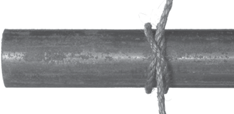
-
- Carrick bend
- Timber hitch
- Clove hitch
- Trucker’s knot
- Which knot multiplies the tension you apply to a rope?
- Timber hitch
- Bowline
- Sheet bend
- Trucker’s knot
- When joining a large diameter rope to a small diameter rope, what should be used?
- Square knot
- Carrick bend
- Sheet bend
- Half-hitch
- When joining two ropes of the same diameter together, what should be used?
- Double half hitch
- Reef knot
- Sheet bend
- Timber hitch
Answer Key: Self-Test B-4.4 is on the next page.