B-4.3 Describe Lifting and Hoisting Communication
Communication Signals for Crane and Hoist Operations
Whenever the operator of lifting or hoisting equipment does not have a direct line of sight to the load, or when radio communication is not possible, a competent signal person must be positioned where they have a clear view of both the load and the operator. The signal person must watch the load at all times and direct all movements of the load from this vantage point. Only one person should signal to the operator of hoisting or lifting equipment at any one time.

A STOP signal can be given by any worker. This is the only signal the operator will accept from anyone other than the signal person.
Communication must consist of previously agreed-upon hand signals or radio contact. The ANSI B30.5 standard requires signal persons to be trained and tested prior to performing crane signaling. Other forms of communication may include bell, light, or horn signals.
Audible Signals
Horn signals for traveling and mobile cranes:
One blast = STOP
Two blasts = FORWARD
Three blasts = REVERSE
Control of Platforms or Skips (Crane-Hoisted Containers):
One bell or light = STOP
Two bells or lights = RAISE LOAD
Three bells or lights = LOWER LOAD
Four bells or lights = ALL CLEAR
Hand Signals
The movement of cranes and loads is controlled using internationally recognized hand signals. These signals are used by all trades involved in lifting or hoisting operations.
If a signal is unclear or not understood, the crane operator must not respond.
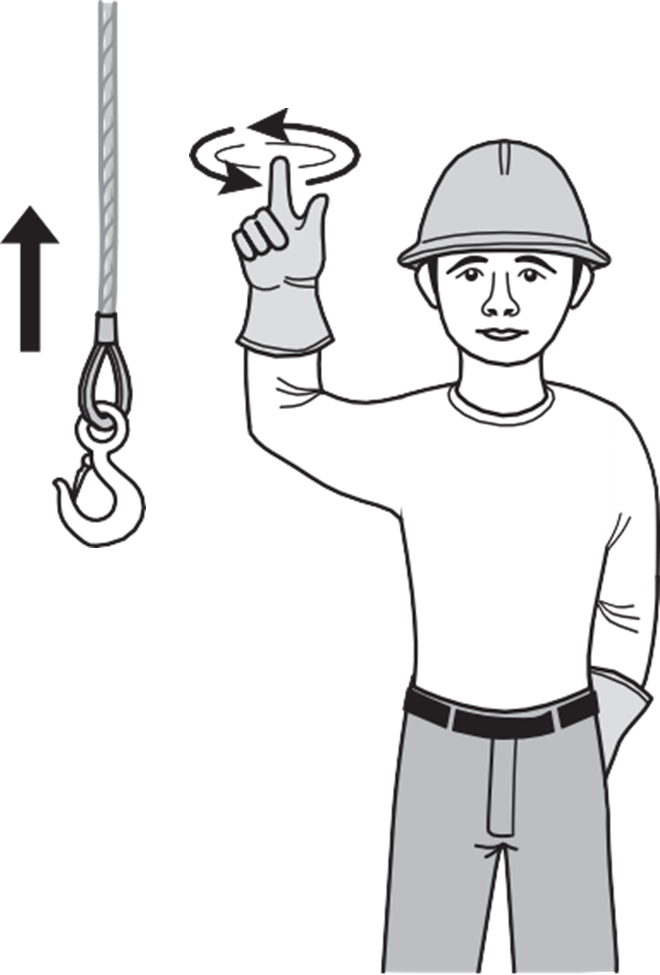
“Raise the Load”
With your upper arm horizontal, forearm vertical, and your forefinger (index finger) pointing up, move your hand in small horizontal circles.
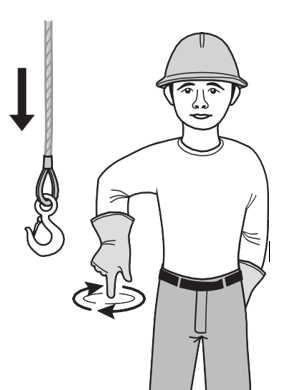
“Lower the Load”
With your forearm extended downward and your index finger pointing down, move your hand in small horizontal circles.
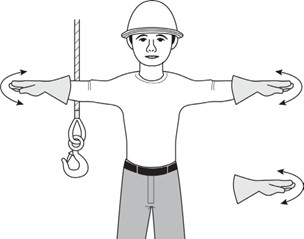
“Stop”
If both your hands are free, extend both arms horizontally with your fingers outstretched. If only one hand is free, face your palm toward the operator with fingers extended and wave your hand side to side.
Boom Signals
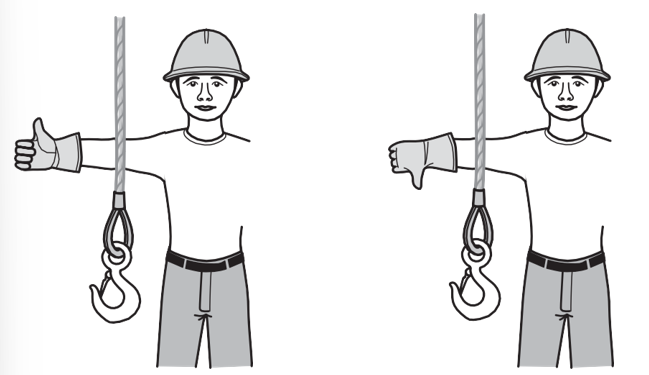
To signal boom movement, extend your arm with fingers closed and use your thumb to indicate whether the boom should be raised or lowered. Remember that boom movement causes the load to move laterally—toward or away from the crane—not just vertically.
Cranes equipped with an extendible or telescopic boom can be signalled to extend (lengthen) or retract (shorten). This is done by holding both fists in front of the body and pointing the thumbs outward (extend) or inward (retract).
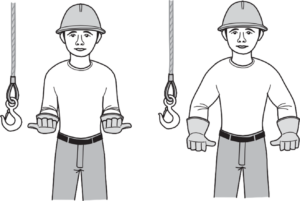
Note: These signals may be performed with only one hand when necessary.
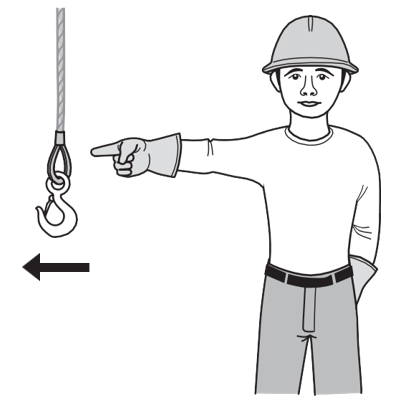
To signal the crane operator to swing the boom, extend one arm and point with your index finger to indicate the direction of the swing.
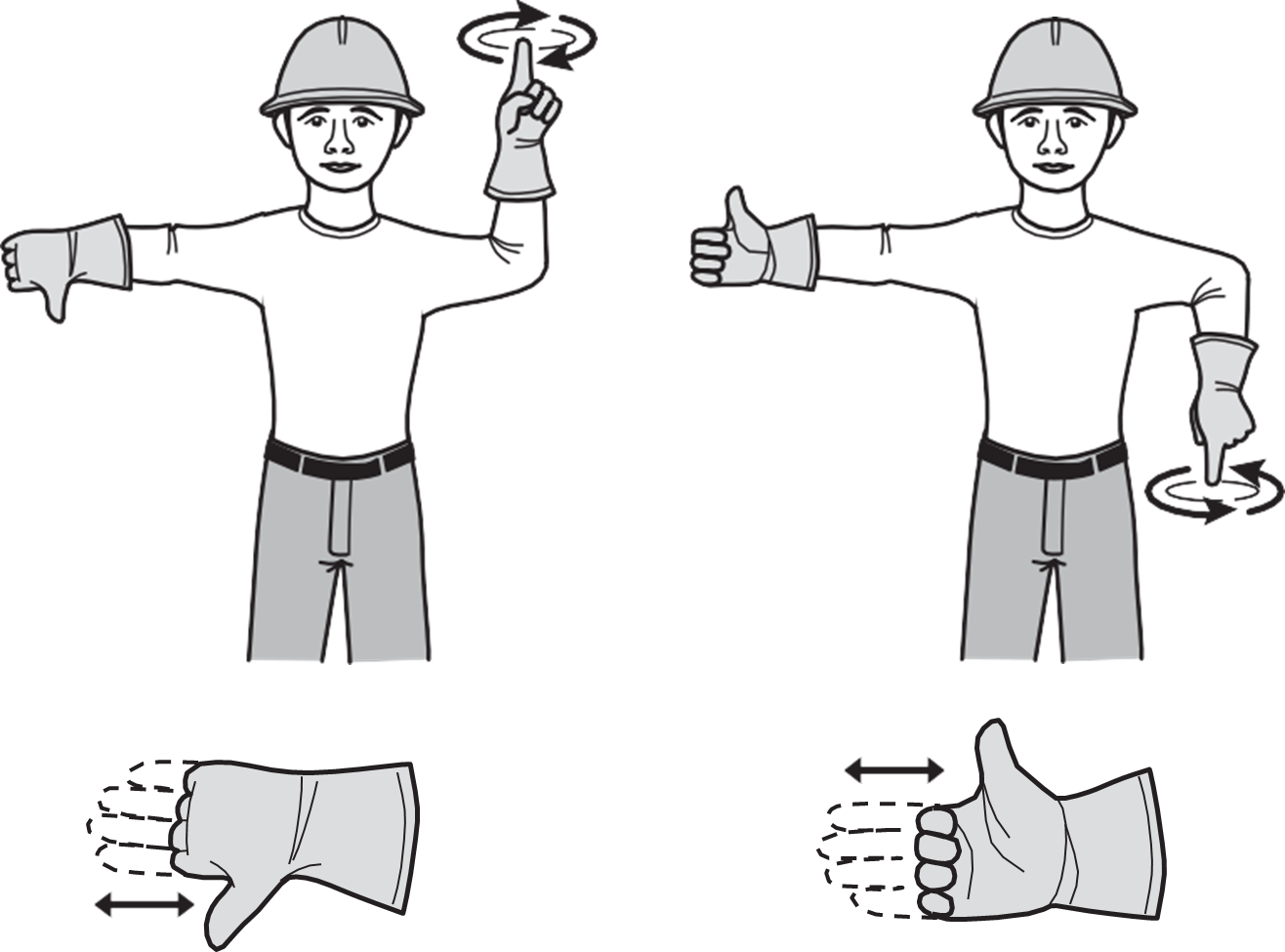
Dual motions can be signaled to the crane operator when required. For example, signaling the operator to lower the boom while raising the load keeps the load at the same elevation, which is useful when avoiding an obstruction. This may be done with one or both hands. When you are using only one hand, your thumb indicates the direction of the boom, and flexing your fingers indicates the movement of the hook.
Line Signals
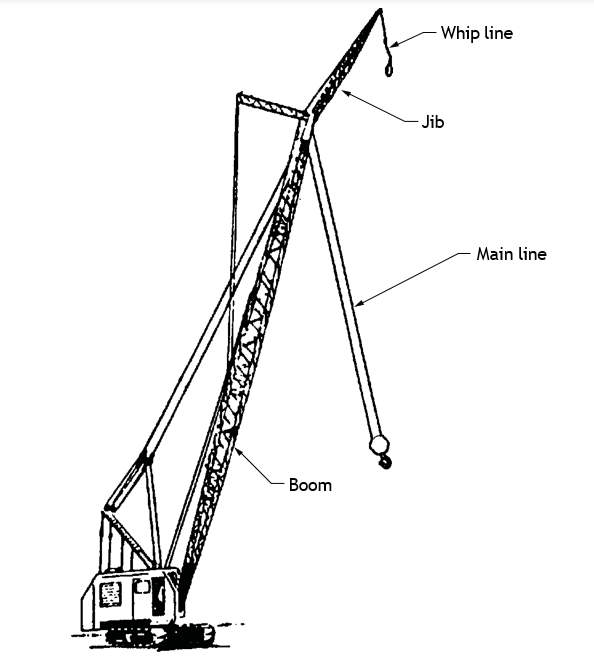
Some cranes are equipped with a jib to extend the crane’s reach for secondary loads or, occasionally, for construction personnel during installation work. From this jib, a whip line or auxiliary hoist is suspended from the jib, while the main line hangs from the boom.
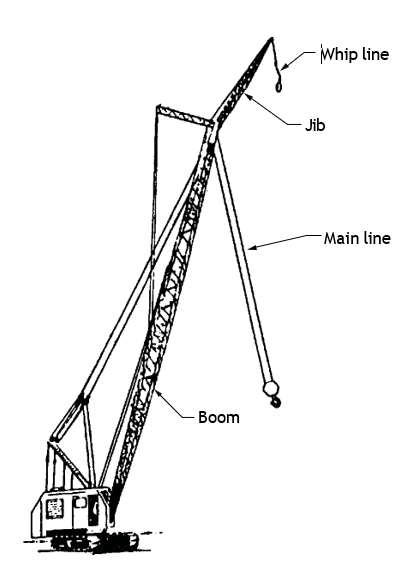
The following signals indicate to the crane operator which line to use.
- Main line: Tap your fist to the top of your head. Then use standard hand signals to direct further movement.
- Whip line: Tap your elbow with one hand (or point to your shoulder. Confirm this variation with the crane operator before the shift. Then use standard signals to direct further motion.
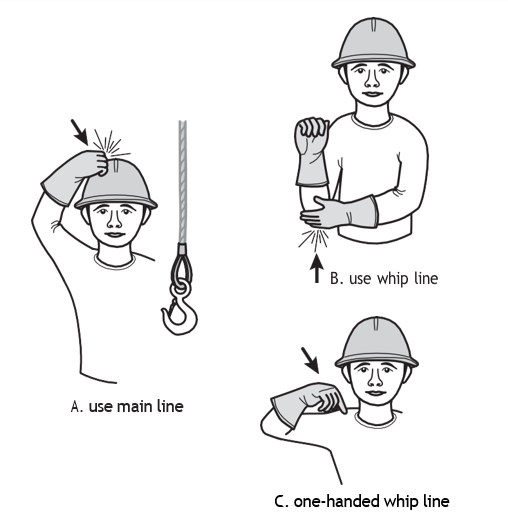
Figure 10 A: use main line B: use whip line C: (alternate) use whip line (BC Industry Training Authority, 2019). CC BY-NC-SA 4.0
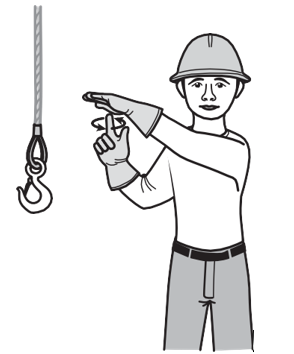
“Move Slowly”
When slow movement is required, hold the palm of your free hand motionless in front of the hand giving the signal for the main line or boom (see example below).
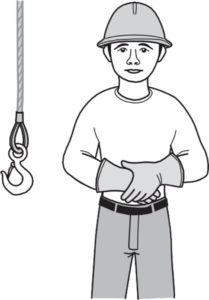
“Dog Everything”
The dog everything signal is given by clasping both hands with thumbs and forefingers together in front of your body. At this signal, the crane operator must lock all crane functions until further instruction from the signal person.
Vertical Hoists
Construction material hoists are used on larger construction projects where the amount of material to be moved warrants the installation of a hoist.
Material hoists must be inspected by a registered professional engineer before the first lift. Light-duty hoists and shingle hoists used for roofing do not require engineering inspection as long as they are set up according to the manufacturer’s specifications.
Workers must never ride a material hoist. Exceptions apply only in critical work environments (e.g., ironworkers or pipefitters accessing high installations) using engineered equipment under strict supervision.
Construction hoists must be inspected weekly unless the manufacturer specifies more frequent inspections.
References for Crane / Hoisting Hand Signals
Standard crane hand signals used in hoisting operations are defined in the WorkSafeBC Occupational Health and Safety Regulation. Similar signal systems are described in CSA and ANSI/ASME crane safety standards.
- WorkSafeBC – Occupational Health and Safety Regulation
- CSA Group: B167: Overhead Cranes, Gantry Cranes, Monorails, Hoists, and Jib Cranes
- OSHA: Standard Crane Hand Signals
- ANSI B30.5: Mobile and Locomotive Cranes
The video Crane Standard Hand Signals: The Complete Guide | Toolbox Talk [10:18] by GotSafety (2024) provides a clear visual demonstration of commonly used signals in real-world contexts. Watching these movements in action can help reinforce the correct form and improve communication during lifting operations. Note: This video demonstrates widely used North American standard crane signals. Always follow site-specific procedures and applicable regulations, such as WorkSafeBC Occupational Health and Safety requirements, when performing lifting operations. Try practicing these signals as you watch the video.
 Self-Test B-4.3: Describe Lifting and Hoisting Communication
Complete Self-Test 4.3 and check your answers.
If you are using a printed copy, please find Self-Test A-4.3 and Answer Key in the Appendix at the end. If you prefer, you can scan the QR code with your digital device to go directly to the interactive Self-Test.

References
ASME. (2021). ASME B30.2: Overhead and gantry cranes (top running bridge, single or multiple girder, top running trolley hoist). American Society of Mechanical Engineers.
BC Industry Training Authority. (2019). Piping trades apprenticeship program: Use Tools and Equipment—Level 1 harmonized [Binder]. Crown Publications, Queen’s Printer for British Columbia. https://www.crownpub.bc.ca/Product/Details/7960000261_S
Camosun College. (2019). Line C: Tools and Equipment—Competency C-3: Describe Rigging and Hoisting Equipment (Rev. ed.) [Learning guide]. BCcampus. https://collection.bccampus.ca/textbook/7c8Ymhnk/
Camosun College. (2015). Trades Access Common Core Competency C-3: Describe Rigging and Hoisting Equipment. Victoria, B.C.: Crown Publications. Download for free from the B.C. Open Textbook Collection (https://open.bccampus.ca/browse-ourcollection/find-open-textbooks/).
CSA Group. (2020). B167-20: Overhead cranes, gantry cranes, monorails, hoists, and jib cranes. CSA Group.
GotSafety. (2024). Crane standard hand signals: The complete guide [Video]. YouTube. https://www.youtube.com/watch?v=1pX2a8qVjE8
Occupational Safety and Health Administration. (n.d.). Crane hand signals. U.S. Department of Labor. https://www.osha.gov/cranes-derricks/hand-signals
WorkSafeBC. (n.d.). Occupational health and safety regulation: Part 15—Rigging. https://www.worksafebc.com/en/law-policy/occupational-health-safety/searchable-ohs-regulation/ohs-regulation/part-15-rigging
Media Attributions
All figures are sourced from Industry Training Authority (2019) and/or Camosun College (2019) and are used under the Creative Commons Attribution 4.0 (CC BY 4.0) licence unless otherwise noted. Images copyrighted by the BC Industry Training Authority are licensed under a Creative Commons Attribution-NonCommercial-ShareAlike 4.0 (CC BY-NC-SA 4.0) licence.
A clear, direct view of the load and work area without obstructions. (Section B-4.3)
A trained worker who gives hand signals or radio instructions to a crane operator during lifting operations. (Section B-4.1)
A secondary hoist line on a crane that is typically lighter and faster than the main hoist line. It is used for lifting smaller loads or for quicker lifting operations. (Section B-4.3)
An additional hoisting mechanism on a crane that operates independently from the main hoist. It is used to lift lighter loads, provide faster lifting speeds, or assist with positioning materials during lifting operations. (Section B-4.3)
The primary lifting cable or hook on a crane used for most lifting operations. (Section B-4.3)
A safety instruction used in lifting and hoisting operations that means to secure or lock all controls and equipment so that no movement can occur. It ensures the load and machinery remain safely in place before workers approach or handle the load. (Section B-4.3)