Self-Test B-1.3 Use Levelling Equipment
Complete Self-Test B-1.3 and check your answers.
- What type of operations are laser and optical levels capable of performing?
- Vertical levelling only
- Horizontal levelling only
- Horizontal and vertical levelling
- Horizontal, vertical and angle levelling
- Which instrument, when set to the fish-eye bubble, needs no further adjustment?
- Transit level
- “Dumpy” level
- Automatic level
- Engineer’s level
- Which one of the following is the only level that is considered accurate throughout the full 360˚ circle without needing further adjustment?
- Transit level
- “Dumpy” level
- Engineer’s level
- Automatic level
- What are the two categories of levels?
- Optical and laser
- Laser and electronic
- Fish-eye and bubble
- Bubble and streaming
- What is the major advantage laser and electronic levels have over optical levels?
- Optical levels are easier to set up.
- Laser levels are less costly than optical levels.
- Optical levels can only use metric levelling rods.
- Laser levels need only one person to operate them.
- Which one of the following has a prism or “compensator” in it?
- Tilting level
- “Dumpy” level
- Automatic level
- Engineer’s level
- How many thumbscrews or “pins” do the least expensive levels typically contain?
- Two
- Three
- Four
- None
- What does a tilting level have that the other optical levels do not?
- Second eyepiece
- Fourth thumbscrew
- Eyepiece focus knob
- Extra fish-eye bubble
- What type of beam does an electronic level use?
- Sonar beam
- Light beam
- Ultra-red beam
- Infrared laser beam
- What following piece of equipment is shared by the optical instruments?
- Crosshairs and stadia lines
- Fish-eye bubble
- Rotating beam
- Sensor
- Label the numbered parts in Figure 1.
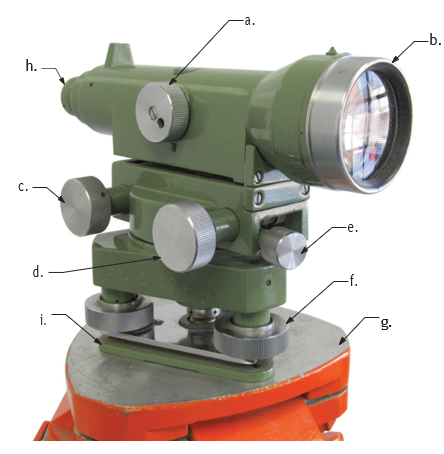
a.
b.
c.
d.
e.
g.
h.
h.
i.
- Where is the knurled knob found that is used to focus the crosshairs on all optical levels?
- At the eyepiece
- At the levelling head
- To the right of the telescope
- Just below the objective lens
- How is focussing the telescope (field of view) accomplished on all optical levels?
- Tilting the barrel
- Realigning the levelling screws
- Turning the horizontal tangent screwturning the focus screw located on the barrel
- Complete the following statement: “The slow motion screw will only operate when…”
- Horizontal clamp is tightened
- Horizontal clamp is loosened
- Tilt screw is tightened
- Tilt screw is loosened
- How are most instruments secured to the tripod?
- Four bolts
- Adhesive tape
- Tongue-and-groove connection
- 5⁄8″ NC female thread connection
- What piece of equipment would a tilting level have that is not found on a “dumpy” or an automatic level?
- Fish-eye bubble
- Split bubble
- Spirit vial
- Tripod
- What is another term for the horizontal slow motion screw?
- Arbitrary screw
- Azimuth screw
- Cosine screw
- Philips screw
- What is the purpose of the stadia lines?
- Measure mass
- Measure height
- Measure speed
- Measure distance
- What is another term for a levelling rod?
- Tuscon rod
- Tallahassee rod
- Philadelphia rod
- Tuktoyaktuk rod
- What are the two types of measuring scales used for levelling rods?
- Feet and inches
- Metric and imperial
- Metres and millimetres
- Architect’s and engineer’s
- What scale would an imperial geodetic elevation be directly read in?
- Metric
- Engineer’s
- Architect’s
- Orthographic
- What would be the distance between the instrument and rod if the upper stadia line reading is 4.357′ and the lower reading is 3.861′?
- 49.60 inches
- 4.96 feet
- 49.60 feet
- 496 feet
- What is the smallest scale division on a metric rod?
- 1 mm
- 10 mm
- 100 mm
- 1000 mm
- What is the smallest scale division on an architect’s rod?
- 1⁄8″
- ¼”
- 3⁄8″
- ½”
- What is the smallest scale division on an engineer’s rod?
- 1⁄8″
- 0.001 ft
- 0.01 ft
- 0.1 ft
- What distinguishing feature is present on the architect’s and engineer’s scales that helps to interpret rod readings?
- Pointed graduations
- Larger numbers
- Yellow lines
- Bold letters
- What would this hand signal indicate?

Figure 2 Image for Question 27. - Come closer
- Finished or OK
- Rod, target or pencil up
- Mark it there, readings complete
- Moving the levelling rod forward and backward slowly through a small arc is done for what purpose?
- Help the instrument person focus
- Ensure the highest rod reading
- Ensure that the rod is plumb
- Keep rain off the rod scales
- What special parts or device should be used when setting up on a floor with a smooth surface?
- Triangle made of wood
- Plumb bob
- Tripod on rollers
- Laser level
- The direction of travel of the bubble will be the same as the movement of what?
- Left finger
- Right finger
- Left thumb
- Right thumb
- When taking a sighting, which one of the following levels needs to be set only to the fish-eye bubble?
- “Dumpy” level
- Engineer’s level
- Automatic level
- Builder’s level
- With the legs closed and extended, to what height should the tripod’s top plate be adjusted before setting the tripod and mounting the instrument?
- Top of your knees
- Centre of your belly button
- Bottom of your chin
- Top of your head
- When setting up a tripod on sloping ground, how should the legs be positioned?
- One leg uphill
- Two legs uphill
- One leg fully extended
- All legs fully extended
- How should all the levelling screws be adjusted?
- As tight as possible
- As loose as possible
- Snugged up but not over tight
- Tightened snugly but with one screw backed off
- Complete the following statement: “Once levelled with the fish-eye bubble, an engineer’s level…”
- Can be read as is
- Will not be very accurate
- Needs no further adjustment
- Must be fine adjusted to level
- What does a four-pin instrument use for setting it up level and ready to use?
- Tubular level vial
- Fish-eye bubble
- Laser beam
- DC motors
- When checking the accuracy of an instrument, how far apart should the two “checkpoints” or stakes be?
- 10 × 2 = 20 metres
- 15 × 2 = 30 metres
- 25 × 2 = 50 metres
- 30 × 2 = 60 metres
- What should be the maximum error tolerance of the instrument over the distance in the preceding question?
- 3 mm or 1⁄8″
- 6 mm or ¼”
- 9 mm or 3⁄8″
- 12 mm or ½”
- How should an instrument be transported from one job site to another?
- Properly stored in its case
- Moved with just its protective lens caps
- Left for the site superintendent to look after
- Left on the floor of a vehicle without its case
- How should an instrument be placed into its case?
- In any way that it fits
- With or without its lens cap
- Any way, as long as the case is left open
- Must be placed back just as it came out
- How should an optical level be picked up?
- Its base
- Its eyepiece
- Its telescope
- Its focus knob
- How should the lens be cleaned if it has been splattered with mud?
- Should be wiped with a wet cloth immediately.
- Should be wiped with a dry cloth immediately.
- Cleaning should not be done until the lens is dry.
- Wet it with water and dab the mud off with a camel hair brush.
- What should be done after using an instrument in the rain?
- Put it back in its case as is.
- Wipe the whole instrument until it is completely dry.
- Damp-dry everything except the lenses and close it up in its case.
- Damp-dry everything except the lenses and leave it to dry in an open case.
- Complete the following statement: “Sudden extreme changes in temperature…”
- Have no effect on optical levels
- Could cause the interior lens to fog up
- Could result in fogging up the horizontal swing mechanism
- Will only result in making the instrument too hot or cold to touch
- How should the instrument/tripod be carried around a wide-open job site with no obstacles?
- In any manner that is convenient
- With the tripod and instrument held vertically
- Over your shoulder with the instrument pointing forward
- Over your shoulder with the tripod feet pointing forward
- Which of the following is the best way to carry the instrument/tripod around a job site with obstacles such as doorways?
- In any manner that is convenient
- With the tripod and instrument held vertically
- Over your shoulder with the instrument pointing forward
- Over your shoulder with the tripod feet pointing forward
- Vibration has a bad effect on optical levels.
- True
- False
- Allowing the instrument to become hot could make it difficult to level.
- True
- False
- What is a standard residential benchmark?
- 0.00′
- 50.00′
- 100.00′
- 1,000.00′
- What does a backsight determine?
- Benchmark elevation
- Instrument height
- Foresight elevation
- Datum
- Which of the following items should be used as a benchmark at a job site?
- Rim of a manhole
- Any part of a sidewalk
- Concrete block set in the ground
- Wooden peg at the corner of the property
- What is the purpose of “Scotchlite” facing on a levelling rod?
- Cut down on glare
- Make the rod waterproof
- Bring the numbers into sharper focus
- Increase visibility of the rod in poor light
-

Figure 3 Image for question 53. What is the rod reading shown in Figure 3?
- 0.272 m
- 2.800 m
- 2.892 m
- 2.792 m
- What is the rod reading shown in Figure 4?
-

Figure 4 Image for question 54. 0.978 m
- 0.988 m
- 9.088 m
- 9.078 m
-
-

Figure 5 Image for question 55. What is the rod reading shown in Figure 5?
-
- 0.241 m
- 2.401 m
- 2.410 m
- 2.450 m
-
-
- What is the height of instrument?
- 99.203 m
- 101.321 m
- 102.118 m
- 103.439 m
- What is the elevation of station C?
Table for question 57 STA BS HI IFS FS ELEV BM 1.321 100.000 A 2.417 98.904 B 1.998 99.323 C 2.118 - 99.203 m
- 101.321 m
- 102.118 m
- 103.439 m
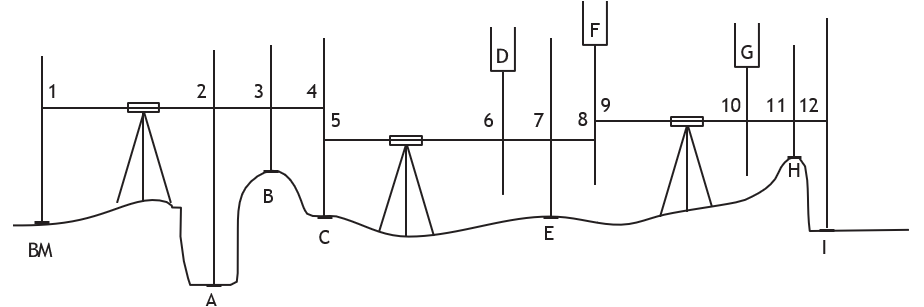
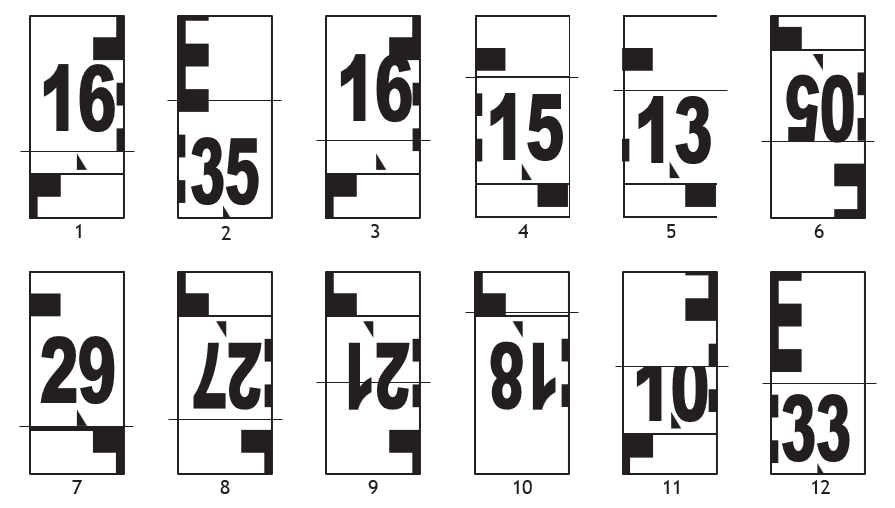
- Figure 6 shows a schematic diagram and some sample rod readings. Use the information contained in them to fill in the field book page in the following table (include a math check). Note that the numbers on the schematic diagram represent corresponding numbered rod sections, and that BM elevation = 100.000 m.
-
- 99.203 m
- 101.321 m
- 102.118 m
- 103.439 m
-
- What is the height of instrument?
| STA | BS | HI | IFS | FS | ELEV |
|---|---|---|---|---|---|
| BM | 100.000 m | ||||
-
- Calculate the elevations of A and B in Figure 7. Grade on drain = ¼”/ft.
-
- Elevation of A =
- Elevation of B =
-
- Calculate the elevations of A and B in Figure 7. Grade on drain = ¼”/ft.
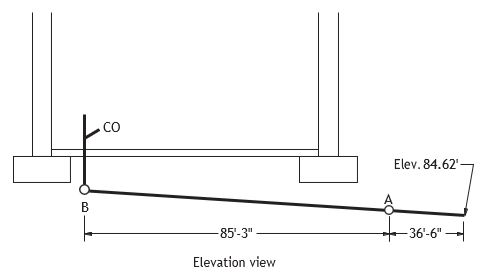
- Calculate the elevations of A and B in Figure 8. Grade on drain = 1/8″/ft.
-
- Elevation of A =
- Elevation of B =
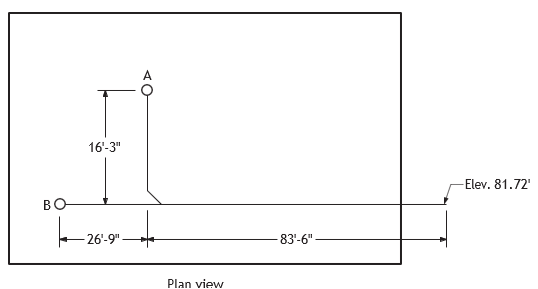
Figure 8 Image for question 60. -
- Calculate the elevations of A and B in Figure 9. Grade on drain = 1⁄8″/ft.
-
- Elevation of A =
- Elevation of B =
-
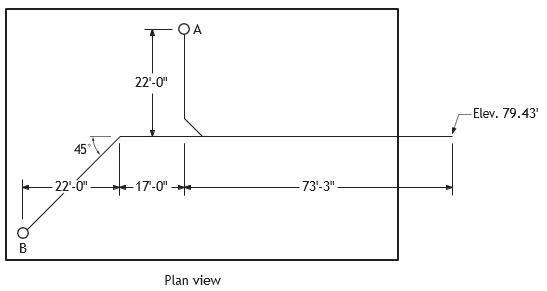
- Calculate the elevations at A and B in Figure 10. Grade on drain = ¼”/ft.
- Elevation of A =
- Elevation of B =
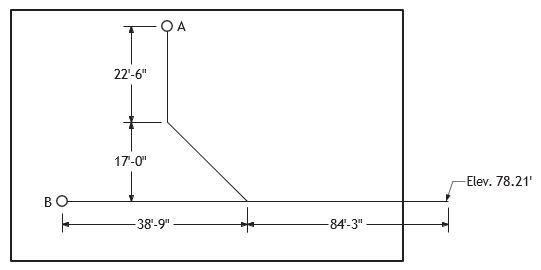
Figure 10 Image for question 62.
- Calculate the following based on Figure 11. Grade on drain = ¼”/ft.
- Elevation of A =
- Elevation of B =
- Depth of drain at B below datum is ____ft ____in.
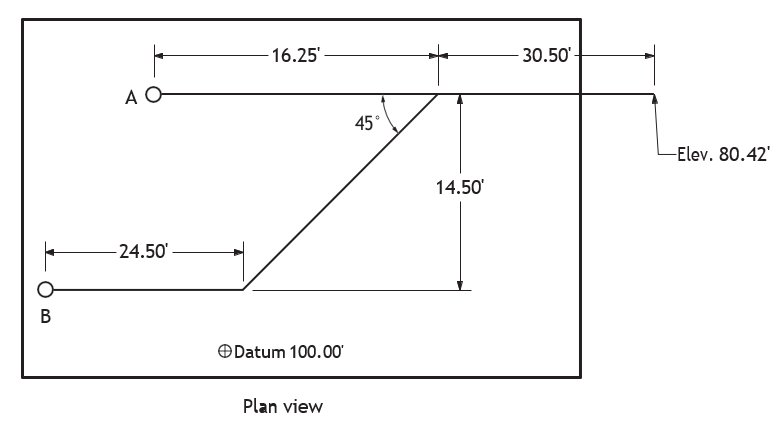
Figure 11 Image for question 63.
- Convert the following readings to feet, inches, and sixteenths.
- 105.25′
- 116.62′
- 145.81′
- 174.39′
- 186.96′
- Convert the following readings to feet and decimal feet, to the nearest 1/100.
- 8 1⁄8″
- 10 7⁄8″
- 1′-3 ½”
- 1′-7 ¼”
- 1′-8 ¾”
- Calculate the grade, expressed as a percentage, if the run of a sewer is 177 feet and the total fall is 3.54 feet.
- Calculate the total fall, to the nearest 1/100 of a foot, if the run is 64 feet and the grade is 1.5%.
- Calculate the length of a sewer if the grade is 1% and the total fall is 0.7 feet.
- Calculate the grade, as a percentage to two decimal places, if the total fall is 18 inches and the run is 115 feet.
- Change ¼ inch per foot to a percent grade to two decimal places.
- What is the rod reading called that is taken on a point whose elevation is known?
- What is the rod reading called that is taken on a point whose elevation is yet to be established?
- Define the term geodetic datum.
Answer Key: Self-Test B-1.3 is on the next page.