B-4.5 Use Hoisting, Lifting and Rigging Equipment
High-Voltage Line Clearance
Use extreme caution when working with a crane near high-voltage power lines. Although you may not be the operator of the crane, you may be rigging or handling the load that the crane lifts.
Keep your distance from power lines! Surrounding every live power line is an area referred to as the “absolute limit of approach.” DO NOT, under any circumstance, move any crane boom, load line, or load into this area unless the power line has been de-energized. There are no exceptions.
This limit of approach varies according to local, provincial, and federal laws and the crane manufacturer’s recommendations, but the generally accepted clearances are shown in Figure 1.

Safety Precautions
- Whenever your work involves moving heavy loads, wear steel-toed safety boots.
- If there is any risk of your hands suffering cuts or abrasions, wear gloves.
- Be alert! Try to anticipate load movements.
- Plan ahead: have an escape route planned in the event something goes wrong.
Care of Slings and Wire Rope
Wire rope and fibre slings should be stored in a dry location off the ground. The strength of a nylon sling is reduced when it becomes wet.
Lubricate wire rope regularly with a light oil to prevent corrosion. You can brush the oil on or pass the wire rope through an oil bath. In either case, it is important to ensure complete penetration of the oil into the inner wires.
Wire Rope Safety
When working with wire rope slings, always wear gloves and eye protection. The following safety precautions should be followed when handling wire rope:
- Use the correct rope for the job.
- Inspect the wire rope regularly.
- Never overload the rope.
- Minimize shock loads by lifting or hoisting and stopping loads slowly.
- Avoid sudden loading in cold weather.
- Take special precautions and/or use a larger rope when:
- The exact load is unknown
- There is a possibility of shock loading
- The conditions are abnormal or severe, or
- There is a hazard to personnel
- Protect rope from sharp corners or edges with padding (use softeners).
- Avoid dragging the rope from under loads or over obstacles.
- Avoid dropping wire rope slings from heights.
- Avoid rolling loads over the slings.
- Store all unused ropes in a clean, dry place.
- Prevent loops in slack lines from being pulled tight and forming kinks. Once a kink has formed in a wire rope, the the damage is permanent. A weak spot will always remain even if the kink appears to have been straightened.
- Never use wire rope that has been cut, badly kinked, or crushed. Obtain approval to destroy and discard any slings or hoisting equipment found to be unsafe.
- Use metal thimbles in eye fittings at all times.
Damage to Wire Rope and Wire Rope Inspection
Individual wire breakage may be found in almost any rope. In most cases, broken wires do not require rope removal if they are at well-spaced intervals. Note the area and watch carefully for any further wire breaks. Clean up broken wires by bending the wire back and forth until the wire breaks off. This allows the broken end to remain inside the rope where it will do less harm. Cutting broken wires with pliers may leave jagged ends that can damage other wires.
A wire rope used for lifting must be permanently removed from service if there are six or more randomly distributed broken wires in one rope lay, or three or more broken wires in one strand in one rope lay.
A rope must also be permanently removed from service if there is more than one broken wire near an attached fitting. Breaks that occur near attached fittings are usually the result of fatigue stresses concentrated in these localized sections. Wire breaks of this type should be cause for replacement of the rope or renewal of the attachment to eliminate the locally fatigued area.
Once broken wires appear in a rope operating under normal conditions, many more will show up within a relatively short period. Attempting to use a rope beyond the allowable number of broken wires will create a hazard.
Worn and Abraded Wires
Each individual wire in a rope, when new, is a complete circle in cross-section. Wear due to friction on sheaves, rollers, drums, etc., eventually causes the outer wires to become flat on the outside, reducing the circle to a segment that gradually becomes smaller as the “flat” increases. These worn areas become void of lubrication and are characterized by their bright appearance. This is part of normal service deterioration and, in most installations where operating conditions are not particularly severe, relatively even abrasion will occur on the outer wires.
Peening
When wire rope strikes against a structural part of the machine or beats against a roller or itself, the wires and strands are flattened and distorted and become brittle. This continuous pounding is called “peening.” Often, this can be avoided by placing protectors between the rope and the object it is striking.
Another common cause of peening is continuous working, under high loads, over a sheave or drum. Where peening action cannot be controlled, it is necessary to have more frequent inspections and to prepare for earlier rope replacement.
Scrubbing
Scrubbing refers to the displacement of wires and strands as a result of wire rope rubbing against itself or another object. This, in turn, causes wear and displacement of wires and strands along one side of the rope.
Fatigue Fractures
Wires that break with square ends and show little surface wear have usually failed as a result of fatigue. In almost all cases, these failures are related to bending stresses or vibration. Fatigue fractures in wire ropes are most often found near a fitting.
Corrosion
Corrosion, while difficult to evaluate, is a more serious cause of wear than abrasion. Usually it signifies a lack of lubrication. Corrosion will often occur internally before there is any visible external evidence on the rope surface. Pitting of wires is cause for immediate rope removal.
Usually a slight discolouration because of rusting merely indicates a need for lubrication. Severe rusting, on the other hand, leads to premature fatigue failures in the wires, necessitating the rope’s immediate removal from service. To retard corrosive deterioration, the rope should be kept well lubricated. In situations where extreme corrosive action can occur, it may be necessary to use galvanized wire rope.
Strands
Replace the rope if the strands are crushed, flattened, or jammed. These conditions usually occur when there are multiple layers on drums. Independent steel wire-cored ropes should be used to prevent crushing. Crushing can also occur if the hoist rope becomes slack and cross-coiled on the drum or trapped in the machinery. No further operations should be carried out until the rope has been paid out, examined for possible damage and correctly re-spooled.
If the rope displays high stranding or unlaying (unwinding), replace the rope or renew the end connection to reset the rope lay. In cases such as this, excessive wear and crushing take place and the other strands become overloaded.
Bird Caging, Kinks and Bulging
“Bird caging” is damage that can result from either a sudden stop, winding on too small a drum, or where the rope is being pulled through tight sheaves. This is cause for rope replacement unless the affected section can be removed.
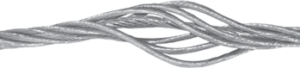
Kinks are usually caused by faulty handling or reeving (where the rope is passed through a hole and stressed). The strands become dog-legged and, where running on sheaves, are subject to excessive wear at the kink. Replace the rope or the affected section of the rope.
Bulging is indicative of core slippage or “turns” being put into or taken out of the rope. Replace the rope, particularly if it is of rotation-resistant construction.
If the rope has gaps, excessive clearance between strands, or core protrusion, replace the rope.
Heat Damage
After a fire or exposure to elevated temperatures, there may be metal discoloration, an apparent loss of internal lubrication or damage to fibre cores. Under these circumstances, the rope should be replaced.
Electric Arcs
Rope that has either been in contact with a live power line or been used as “ground” in an electric welding circuit will have wires that are fused, discoloured, and/or annealed, and must be removed from service.
Hook Safety
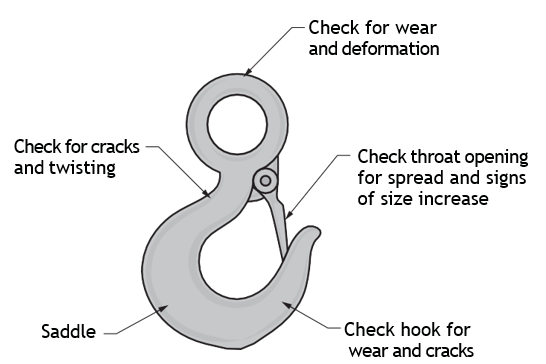
Hooks, like all rigging hardware, must be inspected frequently. You must be alert for signs of wear, particularly in the saddle and the throat opening. Measure the throat’s opening to make sure it is not widening (a sign that the hook has been overloaded and weakened). Check for cracks, corrosion, and distortion. If you discover evidence of wear, immediately discard the hook. Destroy the hook before throwing it away to prevent someone else from attempting to use it.
Safety of Other Hardware
The Workers’ Compensation OHS Regulation requires that every piece of rigging hardware must be tagged with the working load limit (WLL).
Rings, Links and Swivels: Inspect rings, links and swivels regularly for wear, cracks and abrasion.
Eye Bolts and Ring Bolts: Inspect eye bolts and ring bolts regularly for wear, cracks and abrasion. The angle that the sling forms with the eye bolt affects the WLL of the eye bolt considerably. Always try to keep the pull of the sling as close to in-line with the shank of the eye bolt as possible. Use a spreader bar, if necessary, to reduce the angle at the eye bolt.
Turnbuckles: Inspect turnbuckles regularly for wear, cracks, abrasion and deformation.
Shackles: Inspect shackles regularly for wear, cracks and abrasion.
Synthetic Web Slings: Inspect web slings for worn eyes and worn fittings, cuts, holes, punches, tears, frayed material, broken stitching and burns caused by acid, caustics or heat. If a damaged sling is found, remove the sling from service immediately. Do not attempt to repair a damaged sling yourself.
Safe Rigging Practices
Whenever you are handling materials, remember that you are responsible for your own safety and for the safety of others. The best form of personal protection is to stay alert. Before you lift a load, check the rigging components to make sure that they meet the lifting requirements and that the rigging has been safely attached to the load. You must assure that your personal safety and the safety of other workers has not been compromised.
Each circumstance will require that different precautions be taken and the following information should be considered as the minimum safety requirements in any situation.
Personal Protection
Wear safety headgear at all times, but specifically if there is any risk of falling objects or injury to your head.
If the materials you are handling could injure your hands, wear gloves for protection. Gloves should have short cuffs. Gauntlet-type gloves are not safe because the cuffs tend to catch on projections and also serve to funnel dirt and small objects into the glove. If you are handling corrosive or irritating chemicals, wear rubber gloves to prevent skin contact.
When working with materials that are rough and abrasive, wear a protective apron to protect your clothing from becoming worn or ripped.
Your feet should be protected by CSA-approved safety footwear. Always wear safety glasses or safety goggles.
Clothing
The clothing you wear should protect you from dirt, scrapes and abrasions. Your clothing should be loose enough to allow free movement, yet not so loose that it poses a danger of being caught on or in any materials or equipment. All jewellery should be removed, and long or loose hair should be tied back and tucked under a hat or hair net.
Housekeeping
Job-site housekeeping habits can make material handling safe or dangerous. Keep all traffic areas clear to prevent tripping. Spills should be cleaned up immediately to prevent slipping and falling.
Safe Handling of Loads Supported By Cranes
When using slings to attach a load to a crane, ensure that the slings are secure and the load is balanced. Often, when the crane begins to lift the load, the load shifts to one side or the other. If the load shifts, make sure you will not be trapped. Be especially careful to avoid getting your fingers caught between the load and the slings.
If you must apply a sideways force to a suspended load, always push the load away from you. Loads that cannot be adequately controlled must have tag lines attached.
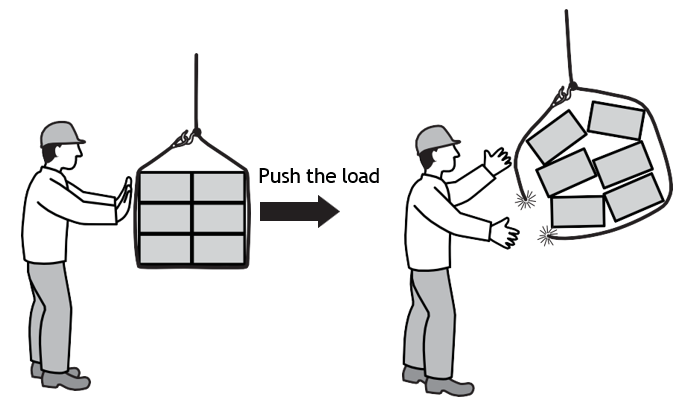
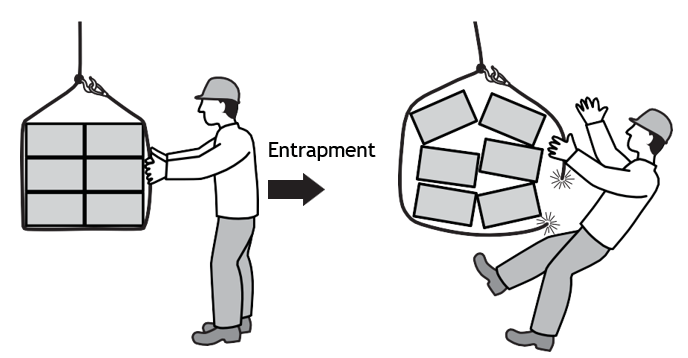
Pulling a suspended load could result in back strain or, much worse, entrapment (as shown in Figure 5) should the load come loose.
Be familiar with the standard signals used in hoisting operations so that even if you are not directly involved, you can anticipate the movement of the load.

Never work under a suspended load. Have a plan of action, including an escape route to safety, in case a suspended load falls.
Tag Lines
Always use tag lines to control the load. Tag lines permit you to control the load from a safe distance. Should the load shift or drop, you will be out of danger.
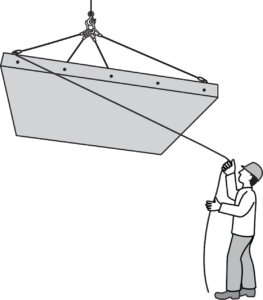

When working with large cranes moving objects near power lines, use a power-line spotter to avoid moving the crane or the load within the safety zone. Electric shock can kill!
Rope for Tag Lines
Every effort should be made to keep away from energized power lines. But if accidental contact is made, the tag line must not conduct the current to the worker guiding the load. Wire rope should not be used, and because nylon lines absorb water, they should not be used.
The preferred rope for a tag line is polypropylene rope. Polypropylene does not conduct electricity and is inexpensive.
Length of Rope
The length of the tag line should be long enough to allow a worker to control the load while it is near the ground or any other structure.
Two Tag Lines
Use two tag lines when the load needs to be maneuvered between or around objects or structures. Use a spreader bar when lifting long pipes with a crane. Use two tag lines, one at each end, to guide longer pipes into place.
Location of Attachment for Tag Lines
Locate tag lines near the end of a long load. Tie the tag line to the load using a bowline. The tag line should be attached to the load so that it will not become trapped when the load is landed.
Safety When Using a Tag Line
The tag line is used to allow the worker to guide the load and still stay out from under it.
Do not stand under the load at any time.

Wear gloves to protect your hands.
Do not double wrap the tag line around your hand or body to avoid entanglement. Keep the tag line clear of your feet.
Note: If there is a sudden movement of the load, do not attempt to hold the load with the tag line.
Do not use the tag line to move the load into position. The tag line is used only for guiding the load. If the crane cannot reach the landing position with the load, the crane will have to move.
Unsafe Rigging Practices
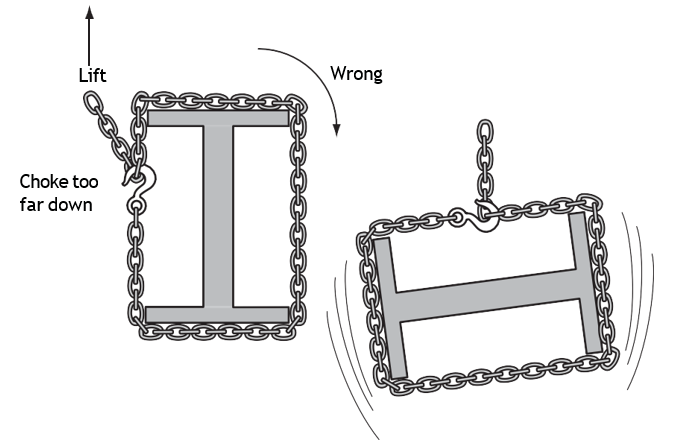
- Never wrap or choke the load with the hoisting line.
- Avoid impact loading caused by sudden jerking when lifting or lowering. Lift the load gradually until the slack is eliminated.
- Never ride the load that is being lifted.
- Never allow the load to be carried over the heads of any personnel.
- Never work under a suspended load.
- Never leave the load suspended in the air when the hoist or crane is unattended.
- Never make temporary repairs to a sling.
- Never lift loads with one leg of a multi-leg sling until the unused legs are made secure.
- Never lift a load with the point of a hook.
Use of Faulty Equipment
Examine all hardware, equipment, tackle, and slings before using it. DESTROY defective components so that discarded equipment may not be used by someone who is not aware of the hazards or defects.
Rigging Structural Shapes
Structural shapes are manufactured with several different configurations and require careful attention when rigging for lifting, turning, stacking, and blocking.
Loose bundles of round stock should be double wrapped with slings prior to lifting to secure those pieces on top of the load. When setting the load down, set it on blocking that has side-restraining chocks (Figure 7) to prevent the pieces from spreading.
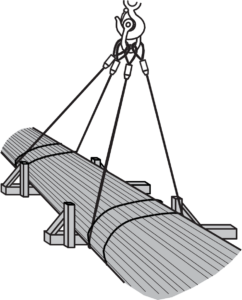
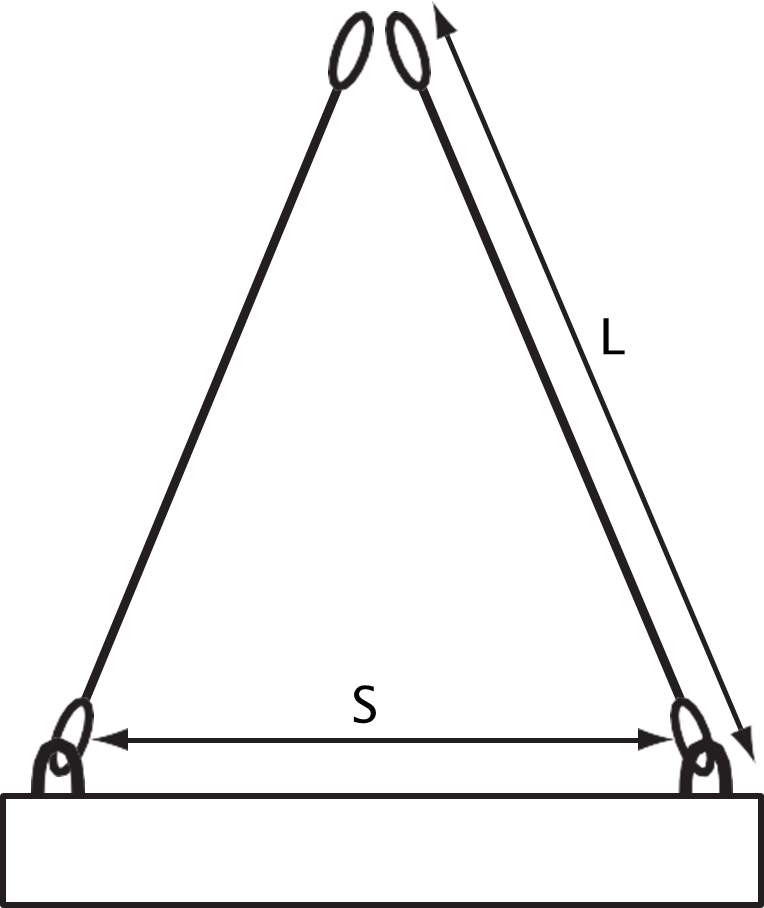
When rigging long loads, use slings with sufficient length that the dimension L is always greater than dimension S. This will ensure that your sling angles are always greater than 60° from horizontal.
Never wrap the sling on the lifting hook to prevent movement. This weakens the sling considerably and may render it useless.

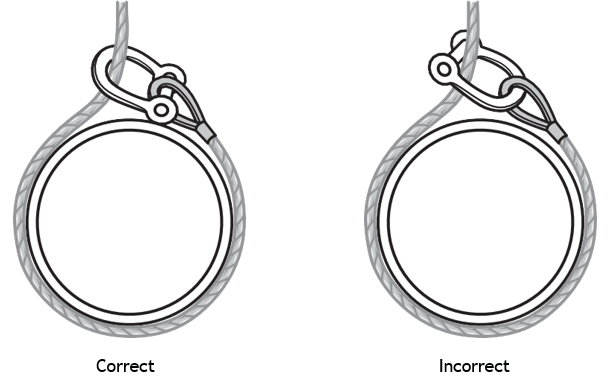
You can form a choker hitch from a looped rope, provided that the loop contains a metal thimble. Rope loops without thimbles can suffer severe abrasion by the cutting section of the line running through the eye.
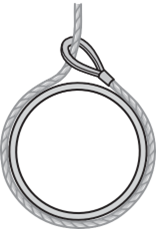
If you are rigging a choker with the aid of a shackle, you must make sure the shackle pin bears on the eye of the sling. DO NOT allow the pin to bear on the running line. The movement of the running line could loosen the shackle pin, causing the load to drop.
When working with large cranes that are moving objects near power lines, use a power line spotter to avoid hitting the lines with the crane or the load. Electric shock can kill!
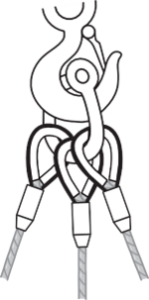
When connecting two or more ropes to the lifting hook, use a shackle to attach the ropes to the hook. The shackle should have the pin bearing on the hook.
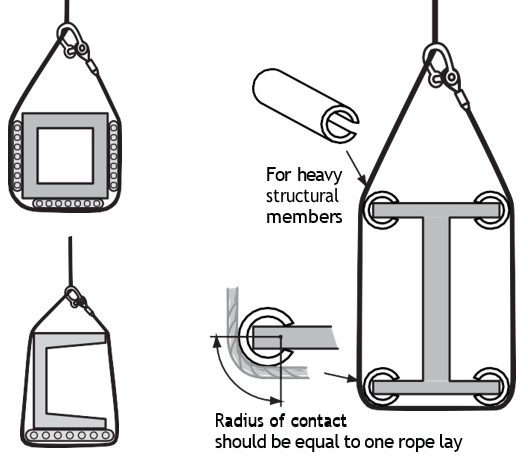
Many structural shapes have sharp edges and corners that can damage slings. To prevent damaging the slings, always provide padding between the sling and the sharp corners of the load.
Turning Loads
When using a crane or hoist to turn heavy structural shapes, you must attach your rigging so that you have full control of the load at all times. Avoid violent or jerky movements because these could cause severe injury to bystanders.
By rigging a load as shown in Figure 14, start the roll by lifting the load. Then by gently lowering the load, continue the roll while maintaining full control.
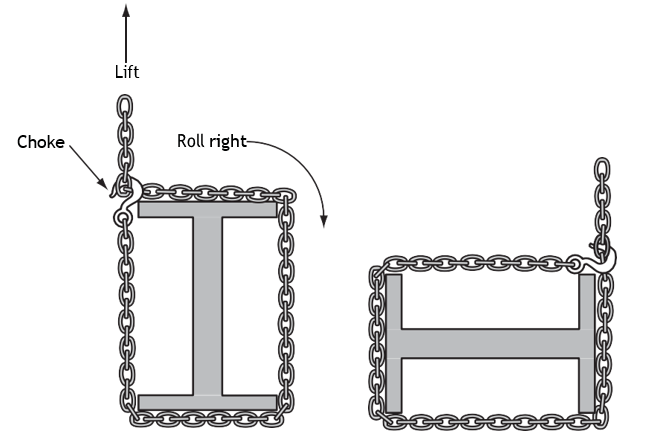
If you were to rig a structural shape, the load would flip violently regardless of how slow you made the lift. The load would then rock back and forth several times before it could be lowered.
Correct Storage Practices
Store materials in such a manner that they are easily accessible and protected from harm. Piles or stacks of material must be securely stacked and pose no threat to people in their vicinity.
To allow cranes or forklifts access to materials, store the materials on dunnage (pieces of lumber for support) blocks or pallets.
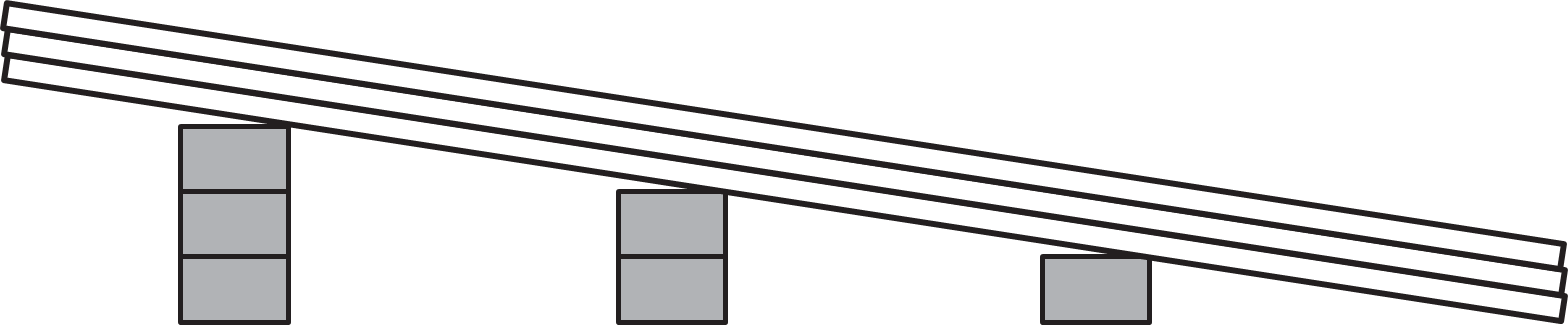
Materials that can be damaged by bending or buckling should be stored on adequate supports to prevent such damage. If materials will be exposed to rain, store them at a slight slope to permit the rainwater to run off.
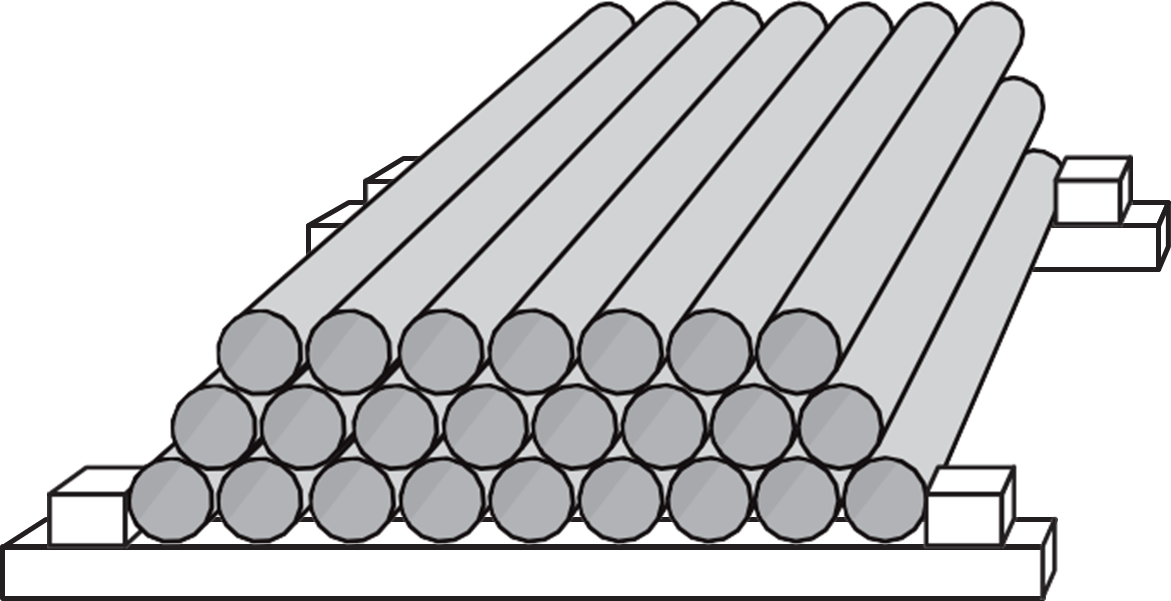
Pipe should be piled with the bottom row of each stack well blocked, as illustrated in Figure 17. The blocking prevents the bottom row from being spread apart by the weight of the subsequent rows. Nail or screw blocking whenever possible. Narrow wedges may be sufficient for small stacks of small diameter pipe, but larger diameter pipe will roll right over them, so use blocking adequate for the situation. Continue to stack rows in a pyramid pattern for stability.
Loose materials should be banded together and stored in containers or bins.
Blocking and Stacking
When stacking structural shapes, you must provide blocking under the first row and cross-sticks between each successive row. The cross-sticks must be positioned directly above the previous row to prevent the materials from buckling and kinking.
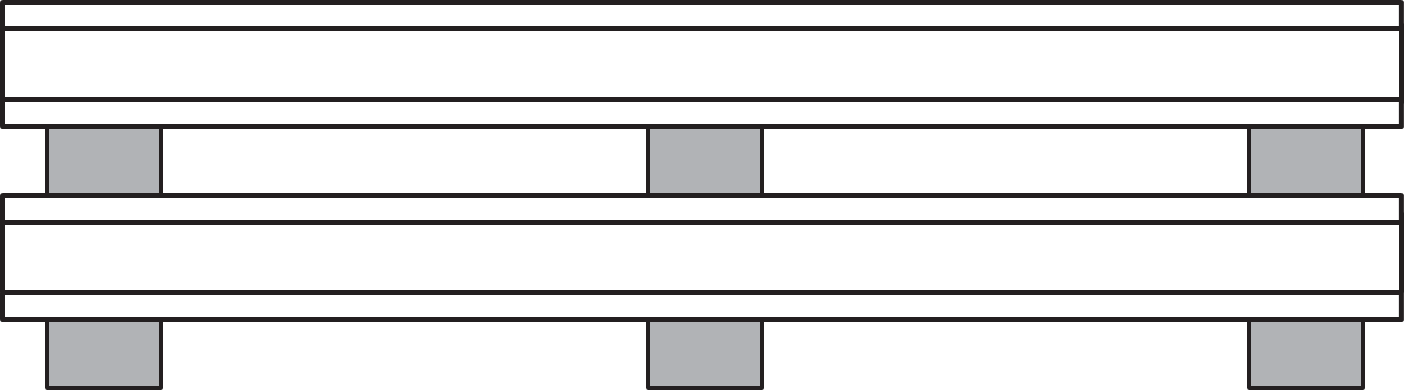
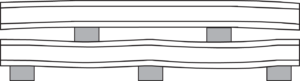
Figure 18 Correct and Incorrect Blocking (BC Industry Training Authority, 2019). CC BY-NC-SA 4.0
 Self-Test B-4.5: Use Hoisting, Lifting and Rigging Equipment
Complete Self-Test 4.5 and check your answers.
If you are using a printed copy, please find Self-Test A-4.5 and Answer Key in the Appendix at the end. If you prefer, you can scan the QR code with your digital device to go directly to the interactive Self-Test.

References
BC Industry Training Authority. (2019). Piping trades apprenticeship program: Use Tools and Equipment—Level 1 harmonized [Binder]. Crown Publications, Queen’s Printer for British Columbia. https://www.crownpub.bc.ca/Product/Details/7960000261_S
-
The competencies Use hoisting, lifting and rigging equipment and Rig loads for cranes (our sections B-4.5 and B-4.6) align with and are adapted from the Piping Trades Apprenticeship Program: Use Tools and Equipment—Level 1 Harmonized curriculum (Industry Training Authority, 2019). See: SkilledTradesBC. (2025). Plumber program outline (harmonized). https://skilledtradesbc.ca
Media Attributions
All figures are sourced from Industry Training Authority (2019) and/or Camosun College (2019) and are used under the Creative Commons Attribution 4.0 (CC BY 4.0) licence unless otherwise noted. Images copyrighted by the BC Industry Training Authority are licensed under a Creative Commons Attribution-NonCommercial-ShareAlike 4.0 (CC BY-NC-SA 4.0) licence.
The minimum safe distance that equipment must stay away from live electrical power lines. (Section B-4.5)
Protective padding placed between a sling and the sharp edges or corners of a load. Softeners help prevent damage to the sling and reduce wear or cutting while lifting. (Section B-4.2)
A sharp bend in a wire rope that damages the rope and weakens it. (Section B-4.5)
A metal fitting placed inside the eye (loop) of a wire rope or fibre rope to protect it from wear and crushing. The thimble helps the rope keep its shape and prevents damage when the rope is attached to hooks, shackles, or other rigging hardware. (Section B-4.4)
The length along the rope in which one strand makes a complete revolution around the rope. (Section B-4.5)
Damage that occurs when wire rope repeatedly strikes or rubs against a hard surface, causing the wires or strands to flatten, distort, and become brittle over time. (Section B-4.5)
Wear and damage that occur when a wire rope rubs repeatedly against another surface or against itself. This rubbing can cause the wires and strands to shift out of place and wear down over time. (Section B-4.5)
Breaks in wire rope wires caused by repeated bending, vibration, or stress over time. These breaks usually appear as clean, square-ended wire breaks and often occur near fittings or areas where the rope bends frequently. (Section B-4.5)
The gradual damage or weakening of metal caused by chemical reactions with the environment, such as exposure to moisture, air, or chemicals. In wire rope and rigging equipment, corrosion often appears as rust and can reduce the strength and safety of the metal. (Section B-4.5)
A condition where the strands of a wire rope begin to loosen, separate, or unwind from their normal twisted position. This can weaken the rope and may indicate damage or improper handling, requiring inspection or replacement. (Section B-4.5)
A type of damage where the strands of a wire rope spread apart and form a cage-like shape. (Section B-4.5)
The process of threading a rope or cable through pulleys or lifting equipment. (Section B-4.5)
A condition where a rope, wire rope, or metal strand becomes bent sharply out of its normal straight alignment, creating an uneven angle that can cause extra wear or weakness in the material. (Section B-4.5)
A condition where metal has been softened by exposure to high heat. When wire rope becomes annealed, it loses strength and hardness, making it unsafe for lifting or rigging operations. (Section B-4.5)
A metal device used to adjust the tension or length of ropes, cables, or slings. It has a threaded body with two threaded ends that can be tightened or loosened by rotating the central frame. (Section B-4.5)
Pieces of wood, metal, or other material placed under or between loads to support them, keep them off the ground, and prevent shifting or damage during storage or transport. (Section B-4.5)