B-6.1 Describe Safety Requirements and Precautions for Arc Welding
Safety Rules for Operating Electric Welding Machines
The greatest electrical hazard for welders comes from electric welding machines. For this reason, every time you work with these machines, you must follow all the standard safety precautions.
All switches must be clearly marked, all tools and equipment must be properly grounded, and metal ladders must be nowhere near any source of electrical power.
Maintenance of Equipment
The welder who is about to use a machine is responsible for ensuring that the welding machine is in a safe operating condition. The wiring, switches, controls, and cables must all be thoroughly checked before use, and preventive maintenance (such as internal cleaning and lubrication) must be carried out at regular intervals.
In most welding shops, the power supply for arc welding equipment is 230 V, 460 V, or 575 V. These are high voltages that can easily deliver severe or fatal shocks. When performing any internal preventive maintenance work on electric welding equipment, observe the following rules:
- All troubleshooting and maintenance of welding machines must be done only on dead circuits. Make sure that the main power supply disconnect switch is open and locked out.
- All work on main power lines, junction boxes, and fuses may only be carried out by a qualified electrician, in accordance with the requirements of the Canadian Electrical Code. As a welder, your maintenance responsibilities end with your welding machine.
Power Circuit Ground
When you connect an electric welding machine to its main power source, it is extremely important to ensure the main power circuit is properly grounded. Without proper grounding, any stray current that develops could give you or another welder a severe or fatal shock. If you have one hand on an inadequately grounded machine in which a current is flowing and accidentally touch a grounded metal object such as a switch box, you become part of the electric circuit. The resulting electric shock could be fatal.
Welding Cables
The cables on a welding machine should be checked every time the machine is used. You should never use electric current that exceeds the rated capacity of the welding cables on your machine. This is uneconomical but, more importantly, it causes overheating and rapid deterioration of the insulation. Faulty insulation is a hazard. If exposed sections of cable come in contact with any grounded metal object in the welding circuit, they could create an arc, which could in turn ignite any flammable materials in the area.
Make inspection of the cables a standard part of your inspection of welding equipment prior to use. If the cables are in good condition, you can use them. In other cases:
- Be sure the main power source is disconnected and locked out.
- If there are surface cracks in the insulation, repair them with electrical tape before starting the machine.
- If there are breaks in the insulation that expose any wire, do not try to repair it. Replace the cable with one that is in good condition.
Fire Prevention
The electrical welding processes such as Shielded Metal Arc Welding (SMAW) pose as great a fire hazard as the oxy-fuel welding processes. Observe the following points:
- Housekeeping: Ensure that your workplace is as free as possible of combustible materials before you begin to weld.
- If flammable materials cannot be removed from the work area, be sure they are protected adequately from sparks and slag before you start to weld. Use welding blankets.
- Do not weld anywhere near containers of flammable liquids.
- Know the locations and type of fire extinguishers in your immediate work area and their operating procedures.
Eye Protection for the Electrical Welding Processes
When you weld using an electrical process such as SMAW, you must take extreme care to protect your eyes. The infrared and ultraviolet rays that are the products of the arc welding process can cause serious and sometimes permanent injury to your eyes.
The burn that results from the exposure of inadequately protected eyes to the welding arc is known as arc flash. Even a one-second exposure at a distance of 0.5 m (20 in.) is enough to burn the eyes.
Never look at an arc with the naked eye. If you receive an arc flash, immediately report it to your instructor. WCB stipulates a minimum distance of 12 m (40′) between an arc and the naked eye.
Helmets
To protect your eyes, face and neck during arc welding, you must wear a helmet or use a hand shield equipped with a dark filter lens. These lenses come in a range of different shades, each with a different number. Your choice of lens depends on the level of current you are using, since this determines the intensity of the arc. Table 1 lists lens shade numbers recommended for different current settings. These are suggestions only. The sensitivity of your eyes may require that you use a darker lens.
| Level of Current | Lens Shade |
| Below 30A | No. 6 |
| 30-70 A | No. 9 |
| 70-200 A | No. 10 |
| 200-300 A | No. 11 |
| 300-400 A | No. 12 |
| Over 400 A | No. 13 |
If your eyesight requires them, use wide vision or clear magnifying lenses. These special lenses fit behind your filter lens.
Always check the shaded lens in your face shield or helmet before you start to weld to make sure it is not cracked or broken. If it is cracked or chipped, replace it immediately.
If you are in a shop where arc welding is being done, wear flash goggles as protection from arc flash. Similarly, if you are welding near another welder, wear flash goggles in addition to a helmet or face shield to avoid the risk of arc flash anytime your helmet is raised.
Arc Burn
The infrared and ultraviolet radiation that occurs with arc welding can cause damage to improperly protected eyes and cause severe burns to your body. For this reason, you must wear the proper protective clothing and equipment when using the SMAW process.
The amount of protective clothing you require depends on how much welding you are doing and on the welding positions you use. At the very least, when you are performing SMAW, all parts of your body must be covered. Use a flame-resistant leather jacket, aprons and sleeves and, for some jobs, leggings and anklets. Your standard protective clothing for arc welding must also include a peaked cap, leather gloves and safety boots.
For arc welding of any kind, your clothing should be dark to reduce the reflection of the arc. If you suffer burns as a result of arc welding, see your doctor at once.
Hearing Protection
In a welding shop or on a construction site, the noise from weld cleaning, chipping, grinding and hammering, as well as from welding machines and power tools, can cause hearing damage.
The signs of hearing damage can be a constant ringing in the ears, hearing loss, temporary deafness and, in extreme cases, permanent deafness. Hearing loss may occur so gradually that you may not be aware it is happening.
You need protection from both steady state and impact noise. In any shop or on any job site where the general or steady state noise level exceeds 90 decibels or where the impact noise levels are in excess of the maximum indicated by the Regulation, you should wear Canadian Standards Association (CSA) approved ear plugs or earmuffs. Hearing protection devices are rated A, B and C to indicate the noise levels for which they are effective (Table 2).
| Steady State Noise for 8 hrs. (dBA) | Minimum CSA Class of Hearing Protector |
| 85-95 | C |
| 96-105 | B |
| 106-115 | A |
| Over-115 | A muff and B plug |
| Impact Noise | A |
| CSA Standard Z94.2-1974 |
Hearing protection devices can be rubberized earplugs that are inserted into the cavity of the ear or earmuffs, which fit over the ear (Figure 3). When selecting hearing protection devices, make sure that they are CSA approved. Earplugs should be clean, pliable and well-fitting, and earmuffs should be adjusted to fit snugly over your ears.
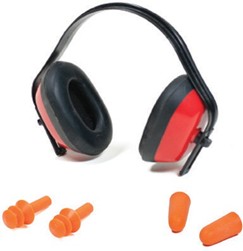
Neither headphones used with music systems nor cotton stuffed into your ears, will give you adequate protection from noise.
Fire and Explosion Prevention
Optional Resource: Real-World Incident
You may be interested in this real-world example from WorkSafeBC (2010): Explosion during welding operation
A worker was welding on an aluminum boat when a welding arc ignited undetected flammable vapours, causing an explosion that threw the worker several metres and damaged the structure.
This incident highlights the importance of proper hazard assessment, ventilation, and testing for flammable vapours before performing hot work.
Flammable Hazards
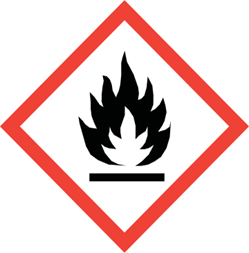
The flammable materials include acetylene, naphtha, turpentine and gasoline. When concentrations of fumes from flammable liquids are present, there is a great risk of these fumes being ignited by contact with an open flame or spark.
The symbol shown in Figure 4 should be located on all containers used for flammable materials.
Flying Sparks
One of the major fire hazards is flying sparks. Unlike flame, the effects of which are confined to the immediate area of the work, sparks travel fast and far. A spark can travel over 9 m (30′) and hold its heat several seconds after landing. Sparks can lodge themselves in cracks and start smouldering fires that may not burst into flames until after you have left the area.
Never weld where sparks may come into contact with flammable vapours, liquids or materials. Sweep floors clean and, if they are wood, wet them down before you light the torch. If there is a possibility that sparks might pass through cracks in walls or floors, cover the holes or move the work.
If you can move your work, set it up in an area that is free from flammable materials. If you cannot move the work, move the flammable material to another area. If neither the work nor the flammable material can be moved, use sheet metal or fireproof guards to keep sparks close within the area of your work. Set pans of water or sand where they will catch dripping slag and pieces of hot metal that might fall.
After you set up the sheet metal or asbestos guards, have someone check to see if sparks are flying over or around them. When you change the direction of flame toward the work, the direction and range of sparks may change. Make periodic checks to see that you are providing enough protection in the right places.
Fire Watchers
Welding and cutting operations should be carried out in areas free from combustible materials. When work must be done near flammable material, the National Fire Protection Association (NFPA) states that you must have a designated fire watcher.
The NFPA also requires the following:
- Fire watchers shall have fire extinguishing equipment readily available and be trained in its use, including practice on test fires.
- Fire watchers shall be familiar with facilities and procedures for sounding an alarm in the event of a fire.
- Fire watchers shall watch for fires in all exposed areas and try to extinguish them only if the fire is obviously within the capacity of the equipment available; if it is not, the fire watcher shall sound the alarm immediately.
- A fire watch shall be maintained for AT LEAST HALF AN HOUR after completion of cutting or welding operations to detect and extinguish possible smouldering fires.
Compressed Gas Cylinders
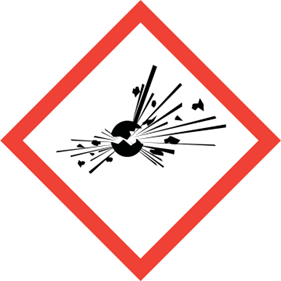
The most common sources of explosive hazards in welding shops are the compressed acetylene and oxygen cylinders used in the oxy-fuel processes. The contents of these cylinders must always be identified on the cylinder. The cylinders must be handled correctly, in accordance with regulations and they must, if possible, be stored in an upright position.
The symbol indicating an explosive hazard is shown in Figure 5 and should be located on all containers or materials that are explosive.
Containers That Previously Held Flammable Material
If containers have previously held flammable materials, welding or cutting them could cause an explosion. Certain preparatory methods of cleaning and purging must be used before welding or cutting is attempted.
One method for removing flammable materials is to steam or boil the container in a caustic solution, a method that is usually too slow, costly and uncertain for commercial work. It may entail days or weeks of processing since lap seams, laminations in the plate of the vessel, or open roots or welds made from both sides may contain pockets of combustibles that are difficult and time consuming to remove.
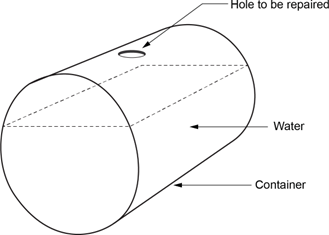
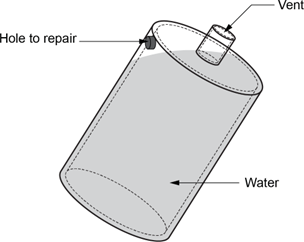
A second and less expensive method is to fill the container with water. The water displaces the air in the container so that an explosion cannot be supported. The container is filled to overflowing, then water is removed to a level just below the hole to be repaired (Figure 6). The air in the container is then checked with a gas detector to ensure that no explosive vapours remain.
There must be a vent hole in the container that is large enough to allow the vapours to escape. Sometimes it will be impossible to leave the vent open, particularly for containers that are positioned on their side (Figure 7). In cases such as these, you have to make sure the hole to be welded is large enough to act as a vent.
Purging is a third method to rid containers of flammable gases. The container is completely filled with an inert gas such as nitrogen, argon or helium, which does not explode. These gases displace the air or oxygen which is explosive.
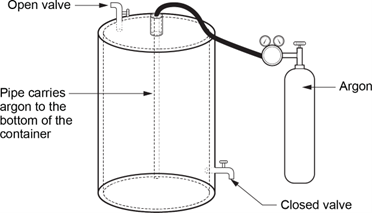
When using this method, you must know whether your purging gas is heavier or lighter than air. If the purging gas is argon, which is heavier than air, you must fill the container from the bottom (Figure 8).
If the purging gas is nitrogen or helium, which is lighter than air, you must fill the container from the top. A vent must be left open to allow the air to escape. Enough purging gas must be used to remove all the air. The procedure should be done in an area free of drafts or wind that would tend to disperse the purging gas.
This method is expensive for ordinary use, but for jobs such as the purging of acetylene manifold systems, this is the best suited method since no moisture or heat is involved.
Steaming is the fourth and most common method of making containers safe for welding or cutting. This process consists of opening all vents and blowing in live steam under pressure until all dangerous traces of combustibles are gone. The container must be welded while it is still hot and full of steam. After cooling begins and air has been drawn into the container, it is no longer safe to weld or flame cut.
The length of steaming time depends on the size and pressure of the steam line, the size of the container and the container’s previous contents. As an extra safety precaution, the container can be filled with inert gas after it has been steamed clean.
Before you begin to weld or flame cut after cleaning or purging the container, you should always test the container using an explosive vapour detector.
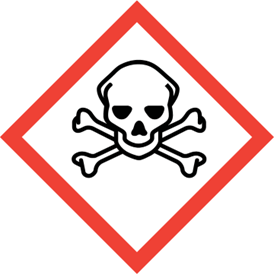
Toxic hazards include the fumes or airborne particles present during welding or produced as a byproduct of welding. The symbol used on containers of toxic materials is shown in Figure 9.
The toxic materials that are most commonly associated with the welding process are in Table 3.
| Substance | Common Source or Use | Health Effects |
|---|---|---|
| Asbestos | Used as insulation for pipes. | Highly toxic. Exposure can cause asbestosis and lung cancer. |
| Beryllium | Used in plating. | Inhalation of fumes can cause coughing, lung inflammation, breathing difficulty, fatigue, weight loss, and heart disease after long exposure. |
| Cadmium | Alloyed with silver or brass; used in silver brazing alloys, plating, or paint coating on some electrodes. Cadmium-coated metals may resemble galvanized metals. | Exposure to fumes can cause breathing difficulty, weakness, general illness, lack of appetite, nausea, metallic taste, chest pain, coughing, decreased urine output, and possibly death from respiratory failure. |
| Carbon dioxide | Used as a shielding gas in some welding processes. | In confined areas, excessive amounts can cause suffocation. May also break down into carbon monoxide in poorly ventilated areas. |
| Carbon monoxide | Byproduct of welding with shielding gas; also emitted by gasoline-powered welding machines. | Colourless and odourless gas. Early symptoms include headache, dizziness, and mental dullness. Severe exposure can cause unconsciousness and death by suffocation. |
| Carbon tetrachlorine and trichloroethylene | Commonly used as degreasing agents. | Exposure can cause abdominal pain, nausea, vomiting, dizziness, confusion, irregular pulse, falling blood pressure, jaundice, and reduced urine output. |
| Chlorine | Used in wood pulp industries and water or sewage treatment plants. | Causes burning in eyes, nose, and throat. Higher exposure may cause nausea, choking, chest pain, lung fluid buildup, and suffocation. Contact with liquid or vapour may cause burns. |
| Cyanide | Used for hardening some steels. | Can cause effects ranging from mild allergic reactions to severe poisoning and death. |
| Fluoride | Found in fluxes used when welding or brazing stainless steel, nickel, aluminum, and magnesium. | Exposure can cause coughing, bronchitis, breathing difficulty, and fluorosis, which changes bone structure. |
| Lead | Found in pipes, paint, electrodes, solders, and sheet materials. | Inhalation causes lead accumulation in organs and bones. Symptoms include metallic taste, nausea, vomiting, gum discoloration, and long-term nervous system damage. |
| Manganese | Used as a deoxidizer and strengthener in steel. | Fumes can cause coughing, bronchitis, fever, headaches, muscle pain, chills, dermatitis, and liver enlargement. |
| Mercury | Found in plating and some paints. | Exposure can cause abdominal pain, excessive salivation, metallic taste, diarrhea, coughing, and reduced urine output. |
| Nitrous gases | Produced by the arc or flame during welding processes. | Can cause breathing difficulty and rapid fluid buildup in the lungs several hours after exposure. |
| Phosgene | Produced when carbon tetrachloride or trichloroethylene is heated or exposed to ultraviolet radiation. | Causes throat irritation, chest tightness, breathing difficulty, lung inflammation, and possibly death from respiratory failure. |
| Ozone | Produced by welding arcs and ultraviolet radiation during electrical welding processes. | Causes irritation of the eyes, nose, and throat. |
| Teflon | Found in pipe linings and tap-valve seals. | When heated above 390 °C (728 °F), it produces highly toxic gases that cause weakness, numbness, throat pain, and breathing difficulty. |
| Zinc | Found in galvanized plating and brass; zinc chloride used as flux. | Exposure to fumes can cause metal fume fever, with symptoms such as headache, chills, fever, chest tightness, and stomach upset. |
Note. Welding fumes from metals such as aluminum, chromium, copper, iron, nickel, titanium, and vanadium are generally not toxic at typical welding concentrations but may become harmful at higher levels.
Ventilation
Adequate ventilation must be provided when toxic fumes from materials such as lead, zinc, cadmium, beryllium and Teflon are present in harmful concentrations.
Ensure that booths or welding screens do not hinder air movement needed for ventilation. Welding booths require a minimum air movement of 30 metres (100 linear feet) per minute.
Although many gases can be identified by their smell, you can never totally rely on your sense of smell. Deadly hydrogen sulphide, for example, is easily recognized by its odour of rotten eggs at low concentrations, but in higher concentrations it becomes odourless. The only reliable method of detecting dangerous gases is to use special detection equipment. These detectors test the air for the presence of explosive vapours and are commonly called explosimeters. Other types of detectors are designed to test the air for the presence of toxic gases such as chlorine or hydrogen sulphide.
Working in Confined Areas
Welding or cutting in confined areas such as tanks, boilers, pressure vessels, vaults and holds of ships requires special attention to safety. The following special precautions are necessary for working in confined areas:
- Check air upon entering.
- Ensure adequate ventilation, especially when using low-hydrogen or stainless-steel electrodes.
- Never use oxygen.
- Keep cylinders outside the confined area.
- Have a helper outside with a lifeline, if necessary.
- Pay special attention to leaks.
- Light your welding or cutting torches outside and have them handed in, if possible.
- Never take welding or cutting torches inside until pressures have been regulated.
- Do not keep torches inside the confined area for any length of time.
- Check for harmful concentrations of ozone during inert gas welding.
- Check for explosive vapours that may be present or produced by the welding.
- Wear appropriate respiratory protective equipment, if necessary.
- Never enter a confined area to rescue personnel overcome by fumes or lack of oxygen without summoning help first; make sure you wear the appropriate breathing apparatus if you do enter.
WorkSafeBC Note: Welding Fumes
Welding fumes can cause serious short- and long-term health effects. Always ensure proper ventilation and follow exposure control procedures.You may be interested:
- Ask an officer: Controlling the risk of welding fume exposures (WorkSafeBC, 2024)
- Controlling Exposure Risks from Welding and Cutting Processes (WorkSafeBC, 2024b)
Respiratory Protective Equipment
Respirators can provide protection against toxic fumes. There are three types of respirators that you may be required to use. The in-line respirator (Figure 10) draws air from a line (fresh air source). A filter in the supply line removes pipe scale, water, oil, mist and noxious vapours. A pressure- reducing valve prevents the pressure of the air from exceeding 170 kPa (25 psi).
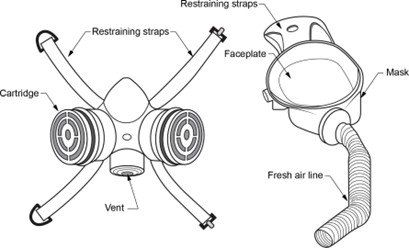
Air-line respirators must be worn during welding or flame cutting operations done either in the presence of toxic fumes or in confined spaces where oxygen levels in the air are inadequate. Typical operations of this kind include the repair of leaks in pipes or tanks containing toxic chemicals or repair work to the inside of large tanks or vessels.
A second type of respirator used for similar operations is the self-contained breathing apparatus (SCBA). Rather than using air from a fresh outside source, this unit draws air from an oxygen cylinder strapped to the worker’s back.
The cartridge-type respirator (Figure 10) is used only for emergency escape. The cartridge in the respirator is able to neutralize the toxic gases for a very short time, allowing you just enough time to get out of the area. In work settings where there is a danger of toxic gas leaks, workers carry this type of respirator on their person at all times. Cartridges are available for different gases, and most types of cartridge provide protection against a range of gases.
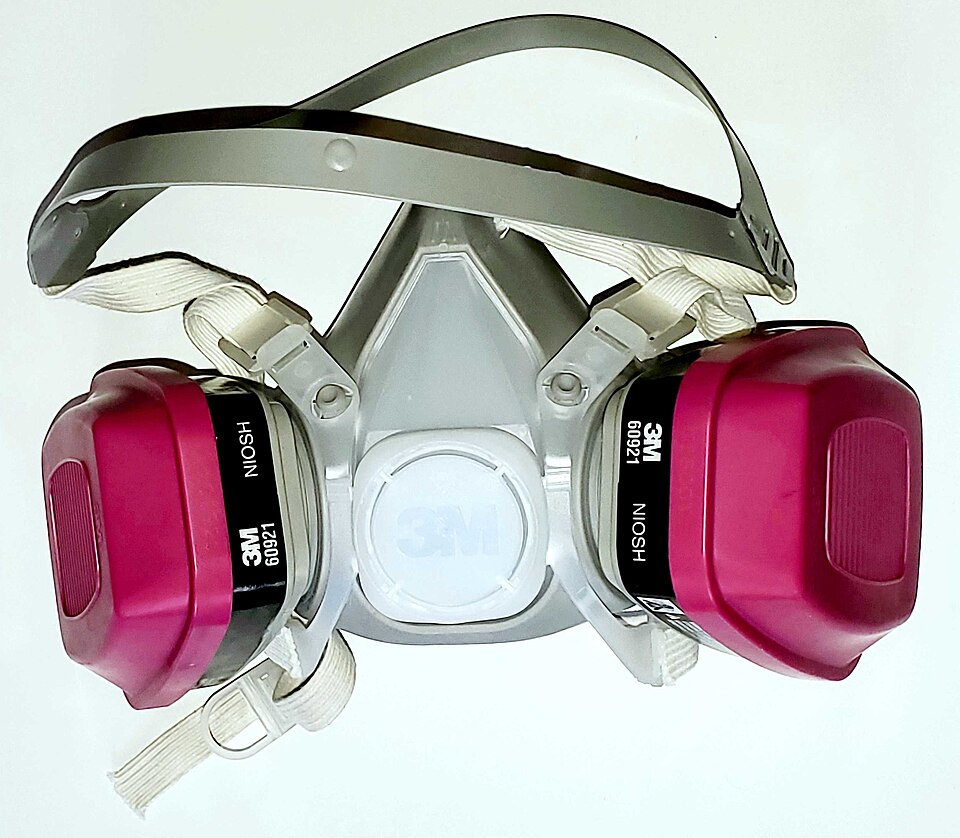
Employees required to wear respirators should keep their equipment clean and sterilized. When not in use, the equipment should be stored in closed containers. The equipment should be inspected regularly for wear or damage. A program should be set up to control the selection, fitting, testing and maintenance of the equipment.
 Self-Test B-6.1: Describe Safety Requirements and Precautions for Arc Welding
Complete Self-Test 6.1 and check your answers.
If you are using a printed copy, please find Self-Test A-6.1 and Answer Key in the Appendix at the end. If you prefer, you can scan the QR code with your digital device to go directly to the interactive Self-Test.

References
BC Industry Training Authority. (2019). Piping trades apprenticeship program: Use Tools and Equipment—Level 1 harmonized [Binder]. Crown Publications, Queen’s Printer for British Columbia. https://www.crownpub.bc.ca/Product/Details/7960000261_S
- Sprinkler Fitter (Harmonized 2018)
- Plumber: Competency B-7 Use Welding Equipment
- Steamfitter: Competency B-5 Use Welding Equipment
Industry Training Authority. (2019). Piping trades apprenticeship program: Level 1—Competency B-5: Use welding equipment (Steamfitter). Crown Publications, Queen’s Printer for British Columbia.
Industry Training Authority. (2019). Piping trades apprenticeship program: Level 1—Competency B-5: Use cutting, brazing and soldering equipment (Plumber). Crown Publications, Queen’s Printer for British Columbia.
Industry Training Authority. (2019). Piping trades apprenticeship program: Level 1—Competency B-6: Use oxy-fuel cutting equipment (Plumber). Crown Publications, Queen’s Printer for British Columbia.
Industry Training Authority. (2019). Piping trades apprenticeship program: Level 1—Competency B-6: Use soldering and brazing equipment (Steamfitter). Crown Publications, Queen’s Printer for British Columbia.
Industry Training Authority. (2019). Piping trades apprenticeship program: Level 1—Competency B-7: Use oxy-fuel equipment (Steamfitter). Crown Publications, Queen’s Printer for British Columbia.
Industry Training Authority. (2019). Piping trades apprenticeship program: Level 1—Competency B-7: Use welding equipment (Plumber). Crown Publications, Queen’s Printer for British Columbia.
WorkSafeBC. (2024a, March 13). Ask an officer: Controlling the risk of welding fume exposures. https://www.worksafebc.com/en/about-us/news-events/campaigns/2024/March/ask-an-officer-controlling-risk-welding-fume-exposures
WorkSafeBC. (2024b). Controlling exposure risks from welding and cutting processes. https://www.worksafebc.com/en/resources/health-safety/books-guides/controlling-exposure-risks-from-welding-and-cutting-processes
Media Attributions
All figures are sourced from Industry Training Authority (2019) and/or Camosun College (2019) and are used under the Creative Commons Attribution 4.0 (CC BY 4.0) licence unless otherwise noted. Images copyrighted by the BC Industry Training Authority are licensed under a Creative Commons Attribution-NonCommercial-ShareAlike 4.0 (CC BY-NC-SA 4.0) licence.
- WHMIS pictograms, pictogram poster and WHMIS labels posters downloaded from the CCOHS (2024) WHMIS Pictograms Kit (downloads) page are used with permission and under the CCOHS terms for educational purposes.
- Figure 11 P100 ovm respirator, by Jcallah on Wikimedia Commons is used under a CC BY-SA 4.0 license.
Connected safely to the earth so that electrical current can flow away and reduce the risk of electric shock. (Section B-6.1)
(Also commonly called stick welding or electric arc welding); A welding process that uses an electric arc between a coated electrode and the metal to join materials. (Section B-6.1)
A painful eye injury caused by exposure to the intense light and radiation from a welding arc. (Section B-6.1)
The process of removing air or hazardous gases from a space by replacing them with another gas or liquid. (Section B-6.1)
A gas that does not react chemically and is used to prevent unwanted reactions such as oxidation or explosions. (Section B-6.1)
The movement of fresh air through a space to remove harmful fumes, gases, or heat. (Section B-6.1)
Harmful gases or airborne particles produced during welding that can cause illness or injury when inhaled. (Section B-6.1)
A protective device worn over the nose and mouth to filter harmful fumes, gases, or particles from the air. (Section B-6.1)
A type of respirator that supplies clean air through a hose from a safe external source, protecting the user from harmful fumes or low-oxygen environments. (Section B-6.1)
A type of respirator that supplies clean air from a tank carried by the user. (Section B-6.1)
A respirator that uses replaceable cartridges to filter harmful gases or particles from the air, typically used for short-term exposure or emergency escape. (Section B-6.1)